
Filemone e Bauci
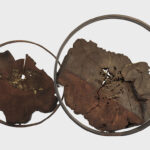
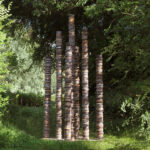
Two elements, mixed media on reclaimed wood, iron, and gold; base Ø 71 cm, h. 183 cm, Ø 104 cm / base 80 × 50 cm, h. 204 cm, Ø 125 cm, 2021
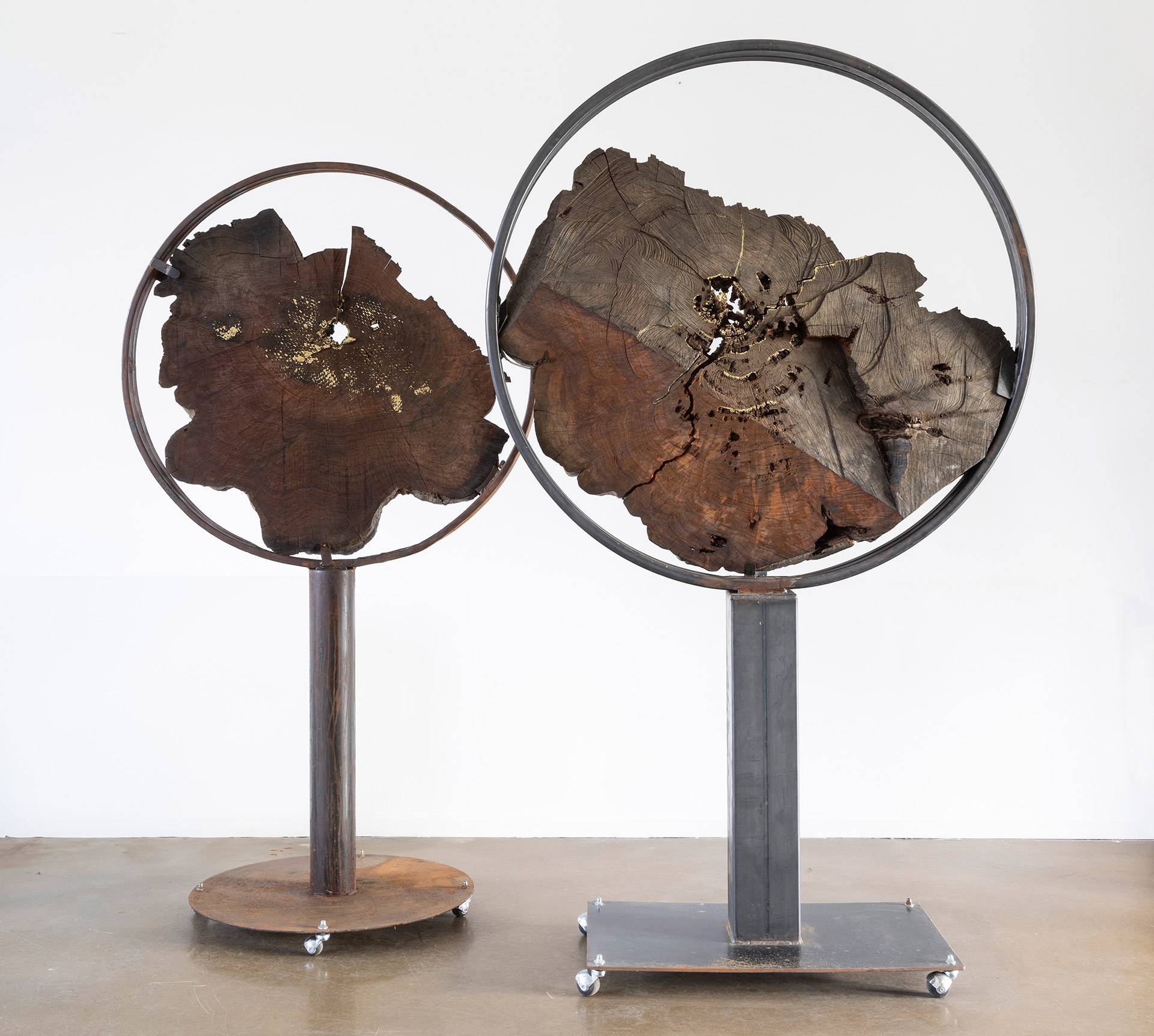
“Filemone e Bauci evokes Ovid’s tale of the same name in the Metamorphoses, inspired by Callimachus’s myth of Hecale.
In Ovid’s account, the hospitality extended by Philemon and Baucis to Zeus and his son Hermes—disguised as ordinary mortals—in their humble hut in a town in Phrygia, and denied by all the other inhabitants, is rewarded by the gods through the granting of the elderly couple’s wishes: namely, to devote the rest of their lives to the worship of the deity as priests and guardians of the temple into which their dwelling has meanwhile been transformed, and to die at the same moment so that neither might outlive the other. At the moment of their earthly parting, Baucis is transformed into a flourishing linden and Philemon into an oak.
In the imagination of artists throughout the ages, the two trees merge into a single trunk, bearing witness to the indissolubility of the marital bond beyond time. Marital love (linden) and moral rectitude and justice (the oak) are what endure for eternity beyond human transience and wrongdoing, a sort of otherworldly creative force intrinsic to the sensible universe that guides every process of transformation in space and time. As in other works by Carlini, the title emerged retrospectively from the artist’s own experience of the sculpture; she approaches the creative and expressive process by allowing herself to be amazed and drawn in by the intimate essence of the material, whose vitality finds a new dimension in the work.
There is, so to speak, no ecological intent or value-driven orientation in the artist’s pre-sculptural motivation. The symbolic and conceptual impact on the viewer is the result of a ‘chaos-germ’ – to borrow a category from the theories of painting developed by Cézanne, Klee, and Bacon – in which the quest for the alchemical transformation of matter is deeply marked by an unconscious transcendental impulse (that is to say, a connection with the otherworldly). This ‘chaos-germ’ expands within the sculpture, minimising established aesthetic codes. The unconscious connection with the universal operates within this creative chaos and finds in the artistic artefact a kind of transmitting antenna for emotions and reflections on pressing existential and social issues (the fate of humankind and the natural world, the safeguarding of the planet from human manipulation, the survival of identity-defining values within civilised communities, etc.), offering them to the viewer.
The sections of wooden logs, embellished with rivulets and sponged-on gold, constrained within iron rings suspended at varying heights on an iron structure with bases of different geometric shapes (circular and rectangular), not only fail to dialogue with one another but also appear incapable of unrestricted expansion. The observer perceives a kind of interruption in the connection with the sky, with the infinite, with the otherworldly, or rather with those a priori categories so dear to Kant. Whilst, on the one hand, the constraint imposed upon the wood suggests to the viewer the denial of cosmic equilibrium by contemporary humankind, which adopts a subversive and manipulative attitude in deference to an unbridled ego, on the other, it reveals the artist’s unconscious spiritual tunnel, her unwillingness to allow herself to be touched by the transcendental Light, which is nonetheless present and active within her.
The reclaimed natural material and the symbolic impact of the work on the viewer act as a catalyst for a sculpture that is, so to speak, ‘sustainable’, in that it advocates the need for sustainable global economic, social, and environmental development that does justice to the same transformative force underlying all sensible reality, the preservation of which is an essential prerequisite for the survival of the planet.
Marco Eugenio Di Giandomenico